
Wedding show timeline: which act fits each stage of the night
From the reception to the dance floor: which act suits each hour of a wedding, how long it runs, what it needs from the venue and what to agree with the DJ.
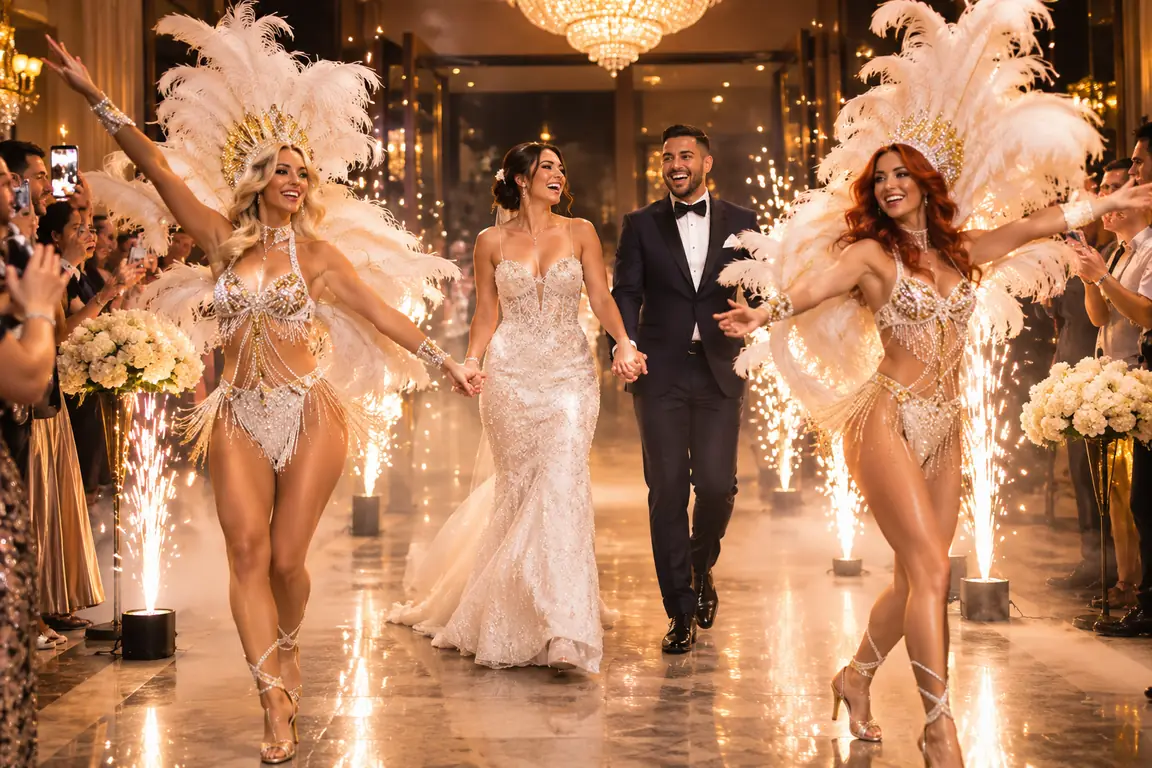
A wedding show timeline is built around the clock of the night, not around the list of acts you liked in videos. A dancer who is brilliant on the dance floor can fall completely flat if she goes on while guests are still looking for their table. The same dancer, an hour and a half later, lifts the whole hall.
So this guide goes by the hour, stage by stage, with what usually works at each one. The acts themselves, with a short description of each, are on the OurEvent home page, and how to choose them by the couple and the venue is covered on the wedding entertainment page.
The times here come from a typical Israeli wedding in a hall or a garden venue, with a reception, the chuppah, the entrance, a first course and a round of dancing. If your wedding starts earlier or runs differently, the stages stay the same and only the times move.
7:30 pm, the reception
In the first hour guests arrive, find their table, queue at the bar and take photos. They are not looking for a show, and they are not ready to stop a conversation for one. What works here is a quiet, beautiful act that photographs well, one people can walk past, admire and move on.
The natural choice is living statues: performers in full costume who stand perfectly still until a guest comes close, and then react. They create pictures that end up in stories before the chuppah, so the reception looks like the opening of the event and not a waiting room. A good alternative is a ballroom couple dancing near the entrance, or a gentle LED act if the reception runs after sunset.
How long? A reception act does not have to run non-stop. Living statues usually work in rounds over 45 to 60 minutes with short breaks, which is enough for every guest to meet them at least once.
8:30 pm, the chuppah
No show goes into the chuppah itself. It is the moment of the couple, the family and the rabbi, and any movement around it only distracts. What you can do is prepare what comes next: the entrance performers get ready during the chuppah, walk the route through the hall and agree the song with the DJ.
If there are living statues at the reception, this is when they finish. Ending one act cleanly before the next begins matters more than it seems, because two acts running at once split the guests' attention.
8:45 pm, the entrance into the hall
After the chuppah the whole hall turns to the door. This is the moment that stays in every wedding video, and it is short: between a minute and a half and three minutes, from the moment the door opens until the couple reaches the dance floor. In that time one strong act beats several small ones.
Options that work well for the entrance:
- samba dancers with feathers who open the way for the couple and stay to dance the first song with them;
- an LED entrance: wings and glowing costumes as the lights in the hall go down;
- a fire show at the door of the hall or on the lawn, only where fire is allowed and at a safe distance from guests;
- a simpler entrance with a ballroom couple, when the couple prefers an elegant, quiet moment.
What decides whether the entrance works is the coordination, more than the type of act. The DJ needs to know at which second of the song the door opens, the photographer needs to stand in the right spot, and whoever runs the lights needs to know when to dim them. All of this is settled a day or two before, in one call.
9:30 pm, the main show
After the first course guests are seated, full, and the dance floor is free. It is the only moment of the night when you can put on a full stage act of ten to twenty minutes and everyone will actually watch it. A belly dancer with wings and costume changes, a samba show, a fire show outdoors, undercover dancers who suddenly rise from the tables, or the singer Onelli with a DJ and dancers.
Undercover dancers are an option people tend to forget. They look like ordinary guests and sit at different tables, and on a certain song they get up one after another and start a show. The effect is especially strong when nobody knows in advance, not even half the family. Just make sure the waiters and the venue manager do know, so nobody clears their table halfway through.
The main show also has to take the speeches into account. If parents or friends speak after the first course, the show should come after them, not before. A show ends the seated part and opens the dance floor, and a speech after it only brings the energy back down.
10:30 pm, the dance floor
In the main round of dancing the music goes up, and what matters now is who gets up to dance. The dancers come off the stage and into the crowd: go-go dancers on the floor, samba dancers pulling guests from the tables, or a short LED act that marks the start of the round.
The trick on the dance floor is not to start too early. If the dancers go on when there are only ten people on the floor, they will dance to an empty room. It is better to wait for the second or third song of the round, when the floor is starting to fill, and then they take it to the peak. A round of dancers on the floor usually lasts 20 to 40 minutes, with a short break in the middle if the night is long.
After 11:30 pm, the end of the night
At many weddings the last hour belongs to close friends. The crowd is smaller, the energy is high, and sometimes this is the time for a last surprise: a short fire show outside before guests leave, or a few minutes of LED dancers on the last song. It is not a must, but it is what people remember on the way home.
How long each act runs and what it needs
The table sums up what usually goes into a wedding show timeline, act by act. The numbers are estimates for a typical wedding; the real plan depends on the venue and the crowd.
| Act | Best stage | Typical length | What the venue needs |
|---|---|---|---|
| Living statues | Reception | 45 to 60 minutes in rounds | A lit corner near the entrance |
| Ballroom couple | Reception, main show | 10 to 15 minutes | A clear dance floor |
| Samba dancers | Entrance, dance floor | 3 minutes at the entrance, 20 to 30 on the floor | Space to get ready with feathers |
| LED entrance | Entrance | 2 to 3 minutes | A way to darken the hall |
| Fire show | Entrance, main show | 5 to 10 minutes | Open ground or the venue's approval |
| Belly dancer | Main show | 10 to 20 minutes | A room for costume changes |
| Undercover dancers | Main show | 5 to 8 minutes | Seats at different tables |
| Go-go dancers | Dance floor | 20 to 40 minutes | Room inside the dance floor |
What to agree with the DJ
The DJ is the person with the biggest influence on how the acts land, more than the producer and more than the venue. A week before the wedding he should have one page with:
- the rough time of each act and the song it comes in on;
- the moment the hall goes dark, if there is LED or fire;
- who gives the signal to start: him, the producer or the performers' contact;
- what happens if a stage runs late, for example if the couple is still taking photos outside;
- the phone number of the performers' contact, so nobody has to search for anyone on the day.
Garden venue, hall or courtyard: what changes
A garden venue usually has more room for a fire show and a long entrance across the lawn, but you need to think about wind, early darkness in winter and dry plants in summer. In a closed hall the lighting is easier to control, so LED and effect entrances look great there, but many halls do not allow fire indoors.
At a wedding in a home courtyard or a villa every small detail matters: where the performers get dressed, where the power runs and how much space is left between the tables. In a place like that, choose two acts instead of four and give each one room to breathe.
If the structure of the night is not settled yet, try the evening planner on the site: pick a wedding and a venue, and it builds a draft by stage and swaps out acts that do not suit the place.
Before you lock the plan
How many acts for a wedding of 300 guests?
Usually two or three: one for the reception or the entrance, one after the first course and dancers for the floor. Beyond that the acts start competing for attention.
One big act or two short ones?
Two short acts at different stages give more than one big moment, because each meets a ready audience. One big act suits a wedding where the point is a single moment to remember, such as the entrance.
What if the venue does not allow fire?
Swap the fire for an LED entrance or samba dancers. The look is different, but the effect on the hall is similar: one moment when everyone looks the same way.
Do we need to coordinate the acts with the photographer?
Yes, and preferably directly. The photographer wants to know where the performers come in, where they stand and when the lights go down, so he does not miss the second the door opens.
What if the schedule of the night runs late?
The performers wait for a signal, not the clock. With one contact person keeping them updated, a half-hour delay does not break the plan.
How far ahead should we book wedding acts?
In the busy season, and especially for Thursdays and Fridays, book at least one to two months ahead. On less popular dates you can book later.
Guests remember the moments when a show met them ready: living statues while they still hold a glass, an entrance when everyone turns to the door, dancers when the floor is already full. Once the clock of the night is clear, the other decisions get simple, and you can move on to settling the details with the performers.